2025. 4. 3. 10:23ㆍExhibit & Column
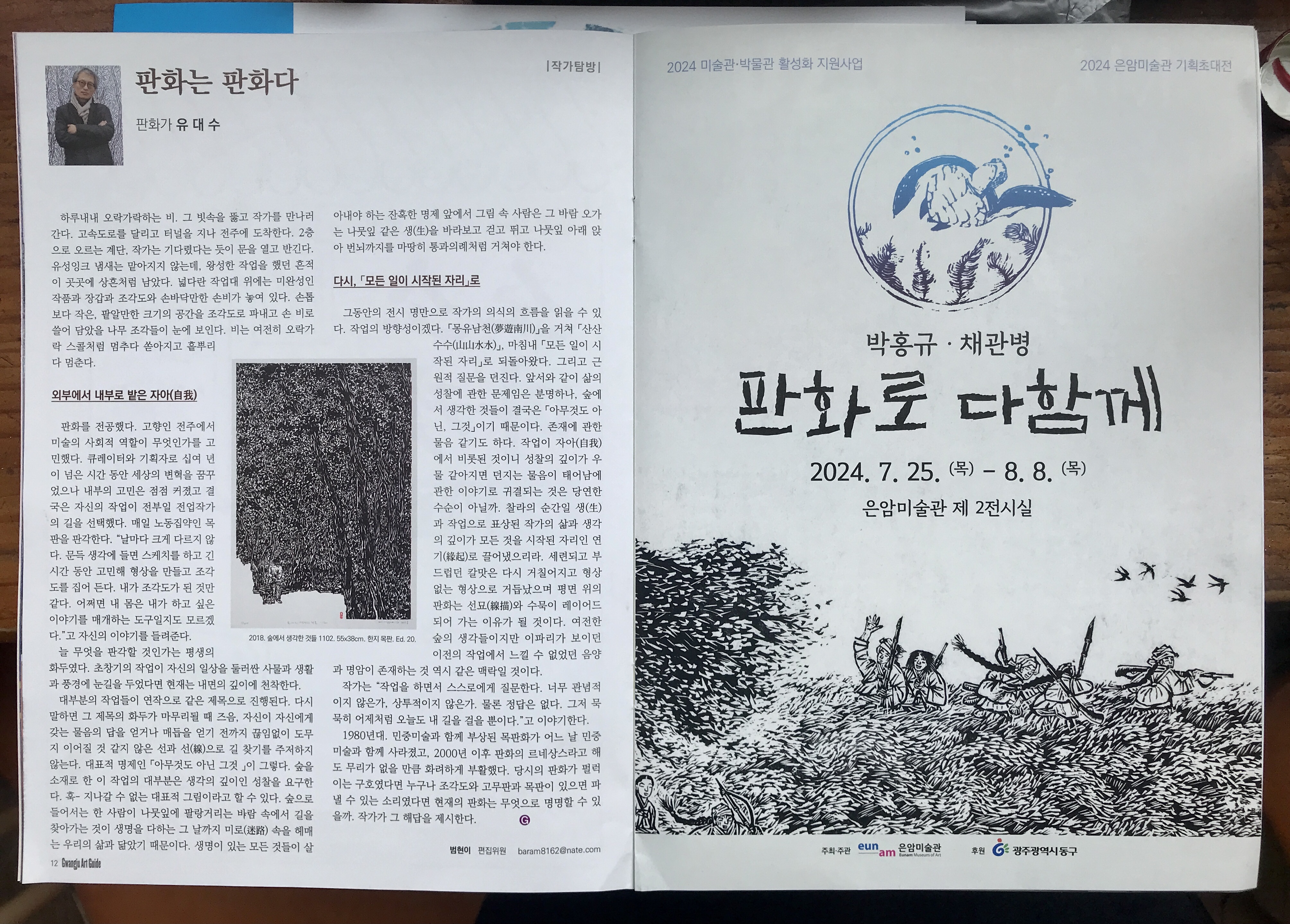

판화는 판화다 - 유대수 작가
범현이(문화전문기자, 오월미술관장)
*이 글은 월간 <광주아트가이드> 177호(2024년 8월호)에 게재된 것입니다.
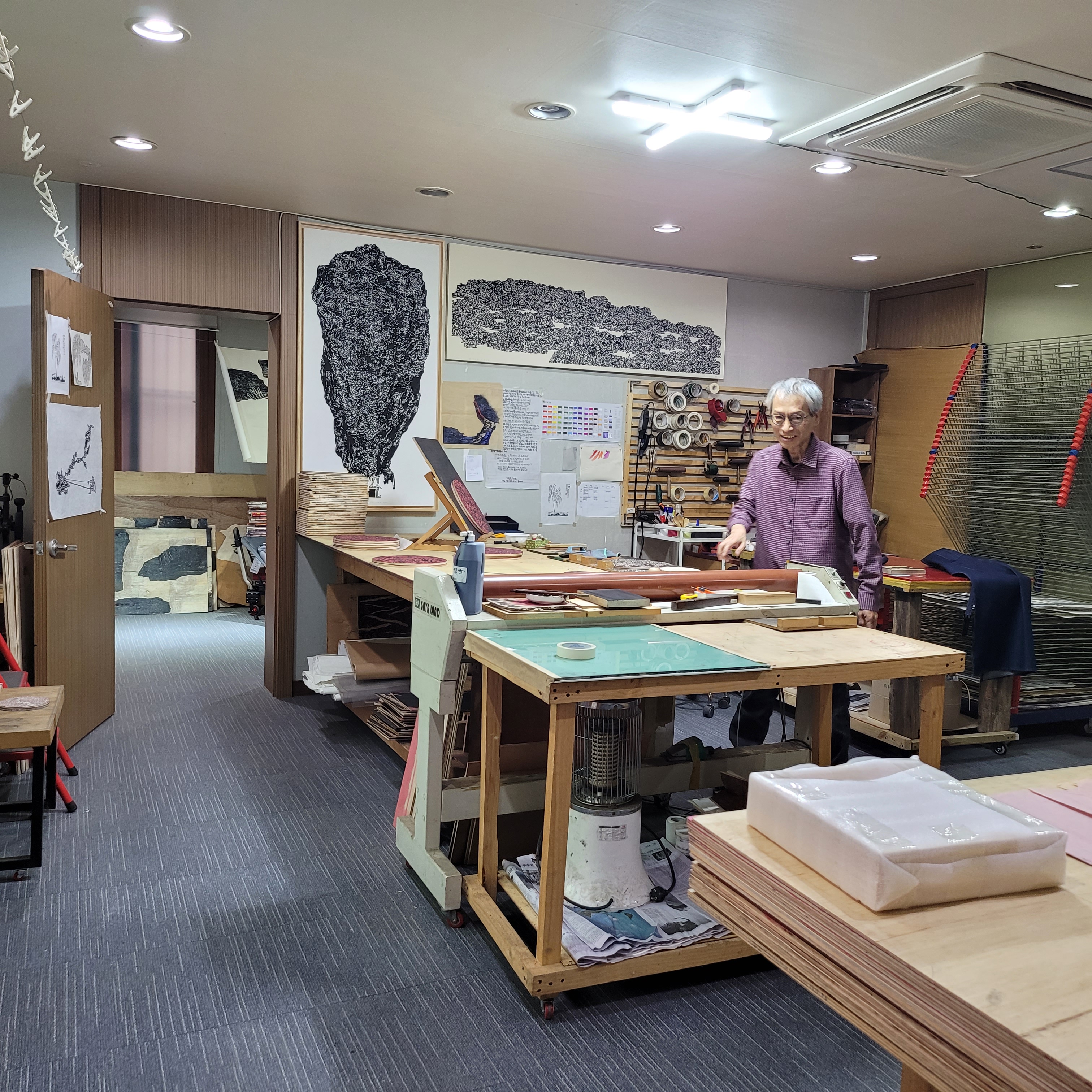
하루 내내 오락가락하는 비. 그 빗속을 뚫고 작가를 만나러 간다. 고속도로를 달리고 터널을 지나 전주에 도착한다. 2층으로 오르는 계단, 작가는 기다렸다는 듯이 문을 열고 반긴다. 유성잉크 냄새는 맡아지지 않는데, 왕성한 작업을 했던 흔적이 곳곳에 상흔처럼 남았다. 널따란 작업대 위에는 미완성인 작품과 장갑과 조각도와 손바닥만 한 손비가 놓여 있다. 손톱보다 작은, 팥알만 한 크기의 공간을 조각도로 파내고 손 비로 쓸어 담았을 나무 조각들이 눈에 보인다. 비는 여전히 오락가락 스콜처럼 멈추다 쏟아지고 흩뿌리다 멈춘다.
외부에서 내부로 밭은 자아(自我)
고향인 전주에서 미술의 사회적 역할이 무엇인가를 고민했다. 큐레이터와 기획자로 십여 년이 넘은 시간 동안 세상의 변혁을 꿈꾸었으나 내부의 고민은 점점 커졌고 결국은 자신의 작업이 전부일 전업작가의 길을 선택했다. 그는 매일 노동집약인 목판을 판각한다. “날마다 크게 다르지 않다. 문득 생각에 들면 스케치를 하고 긴 시간 동안 고민해 형상을 만들고 조각도를 집어 든다. 내가 조각도가 된 것만 같다. 어쩌면 내 몸은 내가 하고 싶은 이야기를 매개하는 도구일지도 모르겠다.”고 자신의 이야기를 들려준다.
늘 무엇을 판각할 것인가는 평생의 화두였다. 초창기의 작업이 자신의 일상을 둘러싼 사물과 생활과 풍경에 눈길을 두었다면 현재는 내면의 깊이에 천착한다.
대부분의 작업들이 연작으로 같은 제목으로 진행된다. 다시 말하면 그 제목의 화두가 마무리될 즈음, 자신이 자신에게 갖는 물음의 답을 얻거나 매듭을 얻기 전까지 끊임없이 도무지 이어질 것 같지 않은 선과 선(線)으로 길 찾기를 주저하지 않는다. 대표적 명제인 「아무것도 아닌 그것 」이 그렇다. 숲을 소재로 한 이 작업의 대부분은 생각의 깊이인 성찰을 요구한다. 훅- 지나갈 수 없는 대표적 그림이라고 할 수 있다. 숲으로 들어서는 한 사람이 나뭇잎에 팔랑거리는 바람 속에서 길을 찾아가는 것이 생명을 다하는 그날까지 미로(迷路) 속을 헤매는 우리의 삶과 닮았기 때문이다. 생명이 있는 모든 것들이 살아내야 하는 잔혹한 명제 앞에서 그림 속 사람은 그 바람 오가는 나뭇잎 같은 생(生)을 바라보고 걷고 뛰고 나뭇잎 아래 앉아 번뇌까지를 마땅히 통과의례처럼 거쳐야 한다.
다시, 모든 일이 시작된 자리로
그동안의 전시명만으로 작가의 의식의 흐름을 읽을 수 있다. 작업의 방향성이겠다. 「몽유남천(夢遊南川)」을 거쳐 「산산수수(山山水水)」, 마침내 「모든 일이 시작된 자리」로 되돌아왔다. 그리고 근원적 질문을 던진다. 앞서와 같이 삶의 성찰에 관한 문제임은 분명하나, 숲에서 생각한 것들이 결국은 「아무것도 아닌, 그것」이기 때문이다. 존재에 관한 물음 같기도 하다.
작업이 자아(自我)에서 비롯된 것이니 성찰의 깊이가 우물 같아지면 던지는 물음이 태어남에 관한 이야기로 귀결되는 것은 당연한 수순이 아닐까. 찰라의 순간일 생(生)과 작업으로 표상된 작가의 삶과 생각의 깊이가 모든 것을 시작된 자리인 연기(緣起)로 끌어냈으리라.
세련되고 부드럽던 칼맛은 다시 거칠어지고 형상 없는 형상으로 거듭났으며 평면 위의 판화는 선묘(線描)와 수묵이 레이어드되어 가는 이유가 될 것이다. 여전한 숲의 생각들이지만 이파리가 보이던 이전의 작업에서 느낄 수 없었던 음양과 명암이 존재하는 것 역시 같은 맥락일 것이다.
작가는 “작업을 하면서 스스로에게 질문한다. 너무 관념적이지 않은가, 상투적이지 않은가. 물론 정답은 없다. 그저 묵묵히 어제처럼 오늘도 내 길을 걸을 뿐이다.”라고 이야기한다.
1980년대. 민중미술과 함께 부상된 목판화가 어느 날 민중미술과 함께 사라졌고, 2000년 이후 판화의 르네상스라고 해도 무리가 없을 만큼 화려하게 부활했다. 당시의 판화가 펄럭이는 구호였다면 누구나 조각도와 고무판과 목판이 있으면 파낼 수 있는 소리였다면 현재의 판화는 무엇으로 명명할 수 있을까. 작가가 그 해답을 제시한다.
A Print is a Print - Artist Yu Dae-soo
Beom Hyun-i (Cultural Journalist, Director of May Art Museum)
Beom Hyun-i’s Artist Exploration, Monthly Gwangju Art Guide, Issue 177 (August 2024)
The Self, Sown from the Outside to the Inside
(...) He carves woodblocks every day, a labor-intensive process. “Each day is not so different. When a thought strikes, I sketch it, then spend a long time contemplating, same the form, and then pick up the carving knife. At times, it feels as though I am the carving knife. Perhaps my body is merely a tool for conveying the stories I want to tell,” he shares. The question of what to carve has always been a lifelong theme for him. While his early works focused on the objects, daily life, and landscapes that surrounded him, his current practice delves deeply into the realms of his inner self.
Most of his works are produced as series under the same title. In other words, until the central question posed by the title is resolved—until he finds an answer or a conclusion to the questions he poses to himself—he continues tirelessly, connecting seemingly unrelated lines in his search for a path. A representative theme is “That Which Is Nothing.” This work, centered around the motif of the forest, demands deep introspection and reflection. It is the kind of artwork that cannot simply be passed by—it draws viewers into its depth and compels them to pause and engage.
A person entering the forest, finding their way amidst the fluttering wind brushing against the leaves, resembles our lives, wandering endlessly through the maze until the day our life ends. In the face of the cruel proposition that all living things must endure, the figure in the painting observes, walks, runs, and sits beneath the leaves, navigating even their anguish as if it were an inevitable rite of passage.
Back to The Place Where It All Began
The titles of his exhibitions alone reveal the flow of the artist’s consciousness, and the direction of his work. From “Dreaming by Namcheon(Mongyu Namcheon)” to “Mountains and Waters(Sansansusu)”, and finally back to “The Place Where It All Began”, the journey comes full circle. Here, he poses fundamental questions. While it is clearly an exploration of life’s reflections, as before, it ultimately circles back to the notion of “That Which Is Nothing.” It feels like a question about existence itself.
Since his work originates from the self, it seems natural that, as the depth of reflection deepens like a well, the questions he poses ultimately lead to stories about birth and existence. The fleeting moment of life, represented through his art and work, intertwines with the depth of the artist’s thoughts and life, drawing everything back to dependent origination(Yeongi)—the place where it all began.
The once refined and smooth carving technique has become rough again, transforming into formless forms. This evolution provides a reason for the layering of lines and ink washes on the flat surface of the prints. While the thoughts of the forest remain consistent, the presence of yin and yang, light and shadow—absent in earlier works where individual leaves were visible—aligns with this same artistic progression.
The artist states, “While working, I ask myself: Am I being too conceptual? Too cliché? Of course, there is no definitive answer. I simply continue walking my path, quietly, today as I did yesterday.”
In the 1980s, woodblock printing rose to prominence alongside Minjung Art (people’s art), only to disappear with it one day. However, since the 2000s, it has experienced a spectacular revival—enough to be called a renaissance of printmaking. If the prints of the past were like fluttering slogans, voices anyone could carve with a chisel, linoleum, or woodblock, then how should we define today’s printmaking? The artist provides an answer through his work.
'Exhibit & Column' 카테고리의 다른 글
| 20240603. 전주천 버드나무 이야기전 (0) | 2025.04.03 |
|---|---|
| 20240501. 전주 국제 실크로드 미술전 (0) | 2025.04.03 |
| 20240127. 판화 그리고 판화 (0) | 2025.04.03 |
| 20230021. 31회 - 전북판화가협회전 (0) | 2025.04.03 |
| 20231108. 홍익판화작가전 (1) | 2025.04.03 |